|
KENT GEOLOGISTS' GROUPWhy collect minerals? |

|
Number of Minerals
There are now over 4000 different mineral types recognised by the International Mineralogical Association (IMA) and new mineral types are continually being discovered, verified and added to the list by the Commission on New Minerals and Mineral Names (CNMMN). Many are extremely rare, frequently occur only as small coloured smudges on a piece of parent rock, and are obtainable only as small specimens that have to be viewed using a microscope.
Some collectors aim to collect as many mineral types as possible.
Crystals and Colour
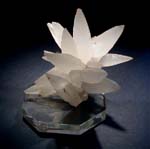
Crystal shape is determined by, and
reflects, the rigid geometrical structure of the
molecule, called the Unit Cell. The unit cell is the building
block of a lattice that determines the crystal shape. All
crystals can be allocated to one of only seven
crystal systems, each containing a number of classes.
The systems and number of classes are cubic (5),
tetragonal (7), hexagonal (7), trigonal (5),
orthorhombic (3), monoclinic (3) and triclinic (2).
Crystal shape is a significant feature in determining
a mineral type in the field.
Colour is the least important feature in identifying
a mineral but minerals occur in every conceivable
colour. For a few examples see the mineral gallery.
Some collectors collect minerals primarily for the aesthetic quality of crystal shape and colour.
Size
Rapid cooling of a liquid yields small crystals. Large
crystals are formed only when cooling is very slow
and crystals have time to grow. As crystals grow they
are subjected to changes in local geology, pressure
and temperature that distort the crystal growth.
Large, perfect crystals are therefore extremely
rare.
Perfect crystals are mostly found only in
micro-specimens.
Micromounters collect small specimens, possibly only match-head size, mounted on a pedestal in a small plastic case measuring no more than 25mm. The specimens are viewed using a microscope.
Micromounters collect small specimens for their rarity and the perfection of crystal shape.
Other Reasons
There are almost as many reasons for collecting minerals as there are collectors.
- Some collect only minerals that they gather themselves. These can come from surface sites such as quarries and mine dumps, or from underground in mines.
- Some collect from a single country, location or even mine.
- Others collect only one mineral type from as many different locations as possible.
- Some collectors specialise in fluorescent or radioactive specimens (see links to "Luminescence" and "Radioactivity" below).
Whatever your reason, there is a wealth of material to catch your interest.
| Minerals | What is Matter? | Atoms, Elements and Compounds | Mineral Gallery |